Quick Answer: recyclable PE pouches from BN Pack have passed independent CTI testing against the EU Packaging and Packaging Waste Regulation (EU) 2025/40, with lead, cadmium, mercury and hexavalent chromium all not detected and both total fluorine and more than 600 targeted PFAS compounds reported below detection limits. The reports, issued in November 2026, cover a mono-material PE/EVOH/PE recyclable food packaging bag plus three additional laminate structures, and they give EU-bound buyers documentary evidence that the pouches they import already meet the regulation’s substance limits that apply from August 12, 2026.
Recyclability claims are easy to make and hard to prove. That gap is exactly what the PPWR was written to close: from August 12, 2026, every package placed on the EU market must be recyclable, and substance limits for heavy metals and PFAS are no longer voluntary eco-label criteria but legal requirements. This article walks through what BN Pack submitted for testing, which limits applied, what the reports actually say, and how the results connect to the regulation’s recyclability grading and the mandatory PCR recycled-content targets that phase in from 2030.
In this article:
- What Went to the Lab
- What the EU PPWR (2025/40) Requires
- The Results: Every Limit Tested, Every Limit Passed
- What the Results Mean for Recyclable PE Pouches
- Where PCR Recycled Content Fits In
- 5 Questions to Ask Any Flexible Packaging Supplier
- FAQ
- The Bottom Line
What Went to the Lab
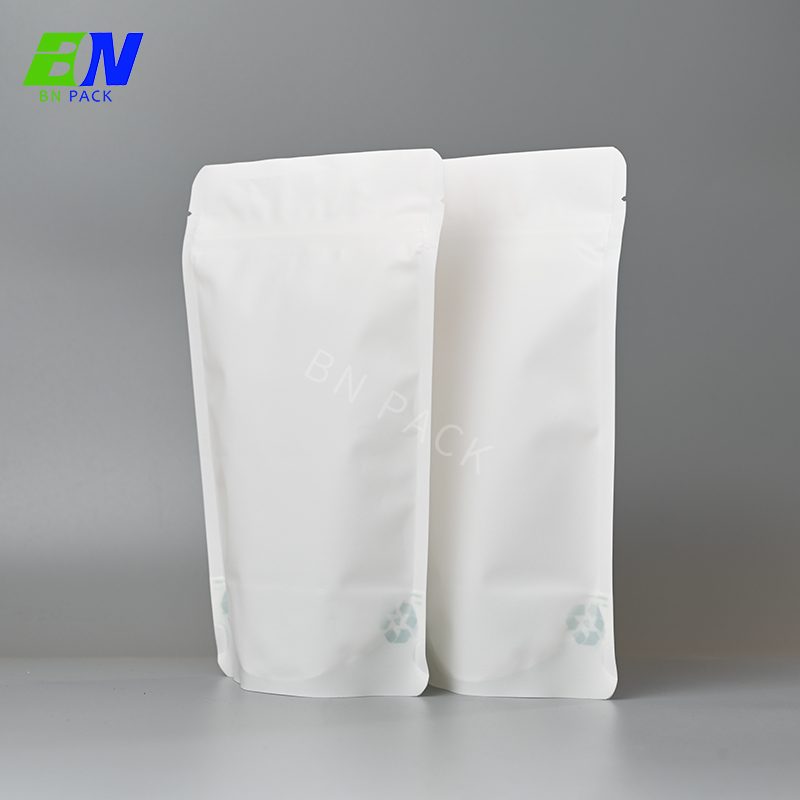
The headline report, A2260844097106001, covers a sample described as a Recyclable Food Packaging Bag with a PE-EVOH/White PE structure – in plain terms, a mono-material polyethylene laminate built for recycling streams. The sample was received by Centre Testing International Group (CTI) in Shenzhen on November 6, 2026, tested through November 12, 2026, and assessed against two PPWR articles: Article 5(4) on heavy metals and Article 5(5) on total fluorine and targeted PFAS. CTI is an ILAC-linked CNAS-accredited laboratory, and the decision rule applied was the binary acceptance statement of ILAC-G8:09/2019.
Three further reports cover the conventional high-barrier laminates BN Pack runs alongside the recyclable family, so buyers can see the same substance limits verified on Matte OPP/VMPET/PE stand-up pouch structures. Report A2260844097101001 (heavy metals) and A2260844097101002 (total fluorine and PFAS) were tested September 22-30, 2026, and report A2260844097102001 extended the picture into food contact, assessing overall migration, specific migration of heavy metals and primary aromatic amines under Regulation (EU) No 10/2011 and Regulation (EC) No 1935/2004 between September 22 and October 14, 2026. A fourth report, A2260677309121001, repeated the heavy metals screen on a white Matte OPP/VMPET/PE SUP sample in September 2026 with the same clean result.
What the EU PPWR (2025/40) Requires
The Packaging and Packaging Waste Regulation replaced the old Packaging and Packaging Waste Directive 94/62/EC and, unlike a directive, applies directly in every member state without national transposition. It entered into force on February 11, 2025, and its core obligations apply from August 12, 2026. The full text is published on EUR-Lex for anyone who wants the primary source.
Two substance rules matter most for flexible packaging buyers. First, Article 5(4) caps the sum of lead, cadmium, mercury and hexavalent chromium at 100 mg/kg across the package. Second, Article 5(5) sets PFAS limits for food-contact packaging from August 12, 2026: any single targeted non-polymer PFAS below 0.025 mg/kg, the sum of targeted PFAS below 0.250 mg/kg, and total fluorine below 50 mg/kg where polymeric PFAS are present. PFAS are the persistent “forever chemicals” used historically in grease-proofing and some surface treatments; the PFAS family numbers thousands of compounds, which is why the test screened hundreds of targeted substances rather than a handful.
The Results: Every Limit Tested, Every Limit Passed
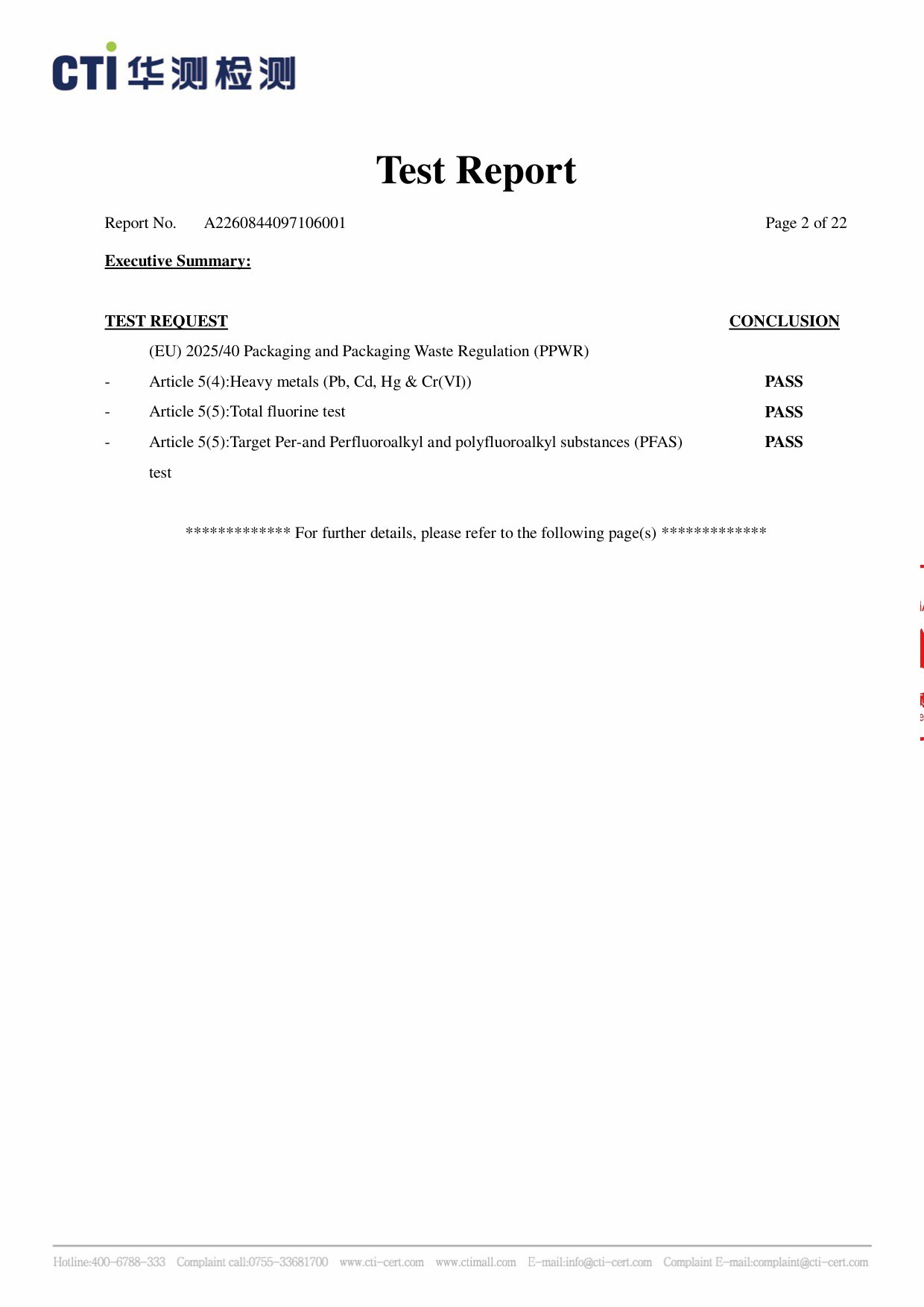
On the recyclable PE/EVOH/PE structure, report A2260844097106001 returned the following summary:
| PPWR Test Request | Method | Result | Limit |
|---|---|---|---|
| Article 5(4): heavy metals (Pb, Cd, Hg, Cr VI) | IEC 62321 series, ICP-OES / UV-Vis | All four not detected | Sum ≤ 100 mg/kg |
| Article 5(5): total fluorine | EN 14582:2016, ion chromatography | Not detected (MDL 10 mg/kg) | ≤ 50 mg/kg |
| Article 5(5): targeted PFAS | EN 17681-1:2025, LC-MS-MS | All tested PFAS below MDL 0.010 mg/kg | 0.025 mg/kg single / 0.250 mg/kg sum (food contact) |
The September reports on the Matte OPP/VMPET/PE laminate tell the same story. Heavy metals were not detected with method detection limits of 2 mg/kg for lead, cadmium and mercury and 8 mg/kg for hexavalent chromium. Total fluorine came back not detected against a 50 mg/kg limit, and the LC-MS-MS PFAS screen found no targeted compound above its 0.010 mg/kg reporting threshold.
Food contact was tested too. Report A2260844097102001 measured overall migration using the BS EN 1186-13:2002 method at 40°C for 10 days, and the result was not detected against a 10 mg/dm² limit. The specific migration screens for barium, cobalt, copper, iron, lithium, manganese, zinc, aluminium, nickel, antimony, the rare-earth group and the absent-result metals (lead, cadmium, arsenic, mercury, chromium) all passed, with primary aromatic amines likewise not detected.
What the Results Mean for Recyclable PE Pouches
Clean substance results are half of the recyclability story. The other half is structure. A traditional stand-up pouch is a laminate of dissimilar families – an oriented polypropylene print web, a metallized barrier layer, a polyethylene sealing layer – and mixed-material laminates are harder for recyclers to process into clean PE recyclate. The tested recyclable PE pouches use a PE-EVOH/PE build: the EVOH barrier layer is present at a small percentage, while the bulk structure, sealant and print surface all sit inside the polyethylene family that European PE recycling streams are built around.
The PPWR translates that logic into grades. All packaging must be recyclable from August 12, 2026, and from January 1, 2030 packaging is graded by the share of mass that can be effectively sorted and recycled: grade A at about 95 percent or higher, grade B at 80 percent, grade C at 70 percent. From 2038 only grades A and B remain marketable.
Designing for recyclability now is how a pouch keeps its grade as the thresholds tighten. Mono-material PE wherever the application allows it, barrier layers kept to the minimum functional share, and adhesives and inks chosen not to contaminate the PE stream are the three moves that matter most. If you are mapping pouch structures against sustainability claims, our overview of biodegradable food packaging and the comparison of compostable coffee bags cover the adjacent options and where each one genuinely fits.
Where PCR Recycled Content Fits In
Substance limits and recyclability are rules one and two; recycled content is rule three. Article 7 of the PPWR sets minimum post-consumer recycled (PCR) content for the plastic components of packaging from January 1, 2030, calculated as a per-facility, per-year average:
| Packaging Category | 2030 PCR Target | 2040 PCR Target |
|---|---|---|
| Single-use plastic beverage bottles (≤ 3 L) | 30% | 65% |
| Other contact-sensitive PET packaging | 30% | 50% |
| Contact-sensitive plastic packaging, non-PET | 10% | 25% |
| Other plastic packaging | 35% | 65% |
Contact-sensitive flexible pouches – the category most food and coffee pouches fall into – carry the 10 percent non-PET target from 2030 if the contact layer is not PET. The supporting delegated acts that define how PCR content is calculated, which recycling technologies qualify, and how third-country recyclate is verified are due for adoption by December 31, 2026, so buyers should expect the evidence chain around PCR claims to get stricter, not looser. A structure that already sorts into a clean PE stream is the same structure most likely to accept PCR content in its bulk layers later, which is why recyclable PE pouches and PCR planning are one conversation, not two.
5 Questions to Ask Any Flexible Packaging Supplier
- Which PPWR articles were tested, and by which laboratory? Ask for the report number, the accredited lab name, and the testing period – our reports were issued by CTI with explicit report numbers you can quote back to the lab.
- Were the heavy metals screened as a sum? The legal limit is the combined Pb + Cd + Hg + Cr(VI) total at 100 mg/kg, not four separate passes.
- How many PFAS compounds were in the target list? A credible food-contact screen covers hundreds of targeted substances by LC-MS-MS plus a total fluorine screen, not a short legacy list.
- What is the material structure, and is it designed for a recycling stream? Ask which grade the structure is expected to reach under the 2030 design-for-recycling criteria.
- What food-contact evidence exists? PPWR substance limits do not replace Regulation (EU) No 10/2011 and (EC) No 1935/2004 migration testing – a complete file has both.
FAQ
Does a passing test report mean the pouch is officially “certified” recyclable?
No, and honest suppliers will say so. The PPWR does not have a third-party recyclability certificate; it has substance limits, design-for-recycling criteria and, from 2030, graded recyclability performance assessed against those criteria. What report A2260844097106001 proves is that the recyclable PE pouches meet the applicable Article 5(4) and 5(5) substance limits, and that the structure is a mono-material PE build intended for PE recycling streams. Buyers should treat the words “accredited lab test report with a number” as the verifiable claim, not the word “certified”.
Which report numbers cover the recyclable PE pouches?
Report A2260844097106001, tested November 6-12, 2026, covers the recyclable food packaging bag in PE-EVOH/White PE for heavy metals, total fluorine and targeted PFAS. The companion reports A2260844097101001, A2260844097101002 and A2260844097102001 cover the Matte OPP/VMPET/PE stand-up pouch laminates for the same PPWR articles plus EU food-contact migration testing, and A2260677309121001 repeats the heavy metals screen on a white SUP sample.
Do the PPWR substance limits already apply?
Yes for the parts tested. The 100 mg/kg heavy metals cap has applied since February 11, 2025, and the PFAS and total fluorine limits for food-contact packaging apply from August 12, 2026 – which has already passed, so the limits the reports checked against are the ones in force today, not future targets.
Is EVOH still acceptable in a recyclable PE structure?
EVOH is a polar barrier polymer used at low percentages inside PE-based structures, and recognized design-for-recycling guidance treats small EVOH shares in a PE matrix as tolerable because the bulk remains polyethylene. The recyclability grading that matters legally is based on the mass share that is effectively sorted and recycled, which is why keeping the PE family above the grade thresholds – not eliminating every barrier polymer – is the design goal.
Will BN Pack share the full reports?
Serious buyers can request the complete CTI reports, including the methods, detection limits, equipment lists and sample photos, alongside the food-contact migration report. Any supplier who can only offer a one-line claim without a report number, lab name and testing dates should be treated as unverified.
The Bottom Line
As of November 2026, BN Pack’s recyclable PE pouches and its Matte OPP/VMPET/PE barrier laminates hold current, numbered CTI test reports showing full compliance with PPWR (EU) 2025/40 Article 5(4) heavy metals and Article 5(5) PFAS and total fluorine limits, backed by EU food-contact migration testing on the same material family. For EU-bound brands, that combination – mono-material PE structure for the 2030 recyclability grades, clean substance results that apply today, and a documented path to PCR content targets – is what a defensible sustainable packaging claim looks like on paper. Ask for the report numbers, check the dates, and put the file in your technical dossier before your competitors’ buyers put it in theirs.