Quick Answer: In the 5 mil vs 7 mil mylar bag thickness debate, 5 mil is the minimum thickness for food storage and the right pick for quart and gallon bags stored on shelves for 10 to 20 years, while 7 mil is the heavy-duty choice for 5-gallon bucket liners, rodent-prone areas, and 25 to 30 year reserves. Both block oxygen and light when sealed correctly; the extra 2 mils in a 7 mil bag buys puncture and tear resistance, not better barrier performance. The comparison table below breaks it down.
| Feature | 5 Mil Mylar Bags | 7 Mil Mylar Bags |
|---|---|---|
| Thickness | 0.005 inch (0.127 mm) | 0.007 inch (0.178 mm) |
| Puncture resistance | Good | Excellent |
| Oxygen barrier | Near zero transmission | Near zero transmission |
| Best format | Quart / gallon bags | 5-gallon liners, large pouches |
| Cost tier | Budget tier | Premium tier |
| Realistic max shelf life | 20 years | 30 years |
Choosing between 5 mil vs 7 mil mylar bag thickness is really a question of where and how long you store food. This guide compares both thicknesses on durability, barrier performance, sealing, and storage scenarios, then gives you simple decision rules so you never overbuy or underbuy again.
In This Guide
- What Mil Thickness Actually Means
- 5 Mil Mylar Bags: Strengths and Limits
- 7 Mil Mylar Bags: Strengths and Limits
- 5 Mil vs 7 Mil Mylar Bag Thickness Side by Side
- How to Choose: 4 Decision Rules
- 3 Mistakes Buyers Make
- FAQ
- The Bottom Line
What Mil Thickness Actually Means
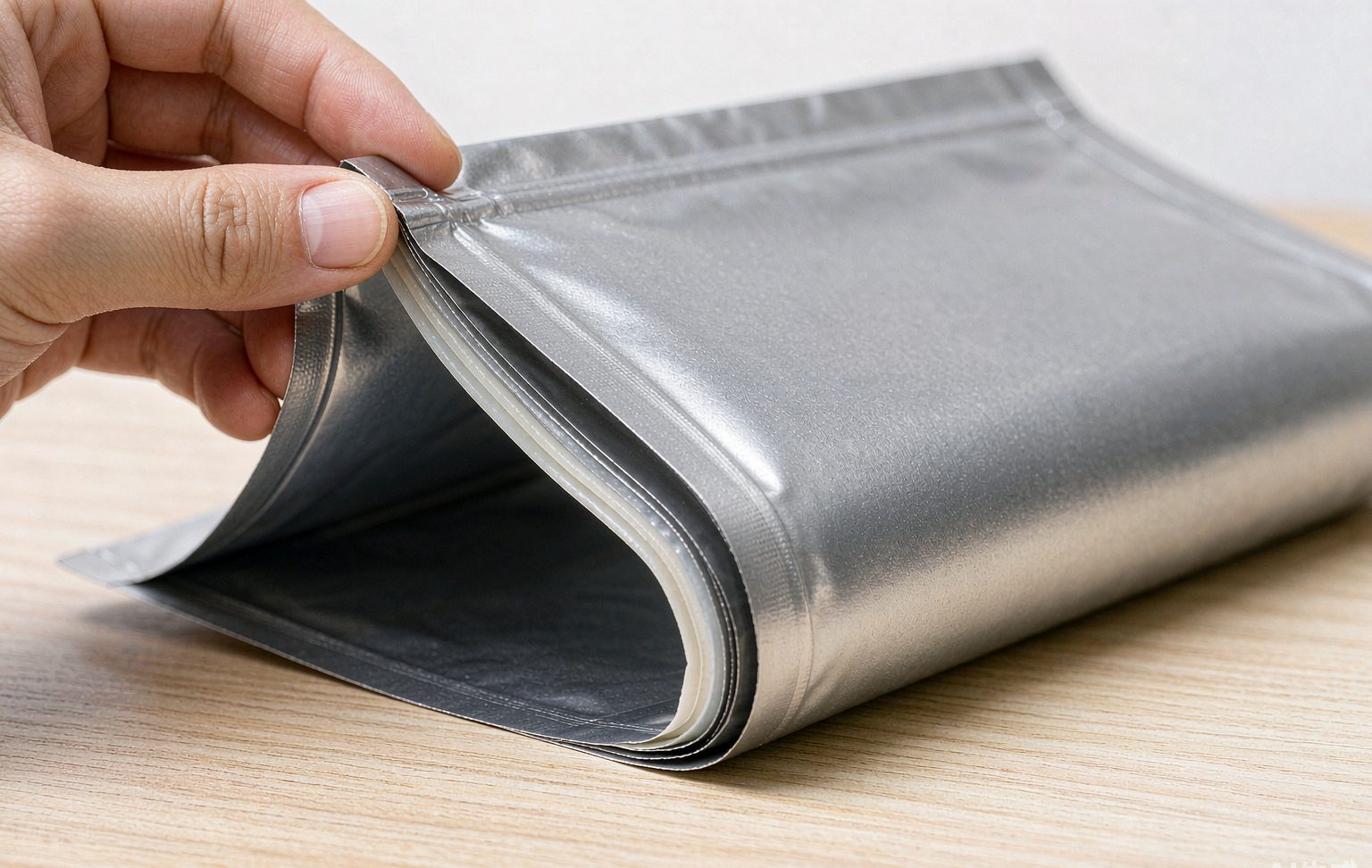
A mil is one thousandth of an inch, so a 5 mil bag measures 0.005 inches and a 7 mil bag 0.007 inches across its laminated layers. That single difference is the technical heart of 5 mil vs 7 mil mylar bag thickness. Mylar itself is boPET film (biaxially oriented polyethylene terephthalate), usually metallized with aluminum and laminated to a food-grade polyethylene liner. The PET-plus-foil layers provide the oxygen and light barrier; the poly liner provides the weldable, food-safe inside surface.
Thickness does not change the barrier chemistry. Both use the same laminate structure, which is why the real question in 5 mil vs 7 mil mylar bag thickness comes down to mechanical strength: resistance to punctures, tears, abrasion, and slow stress at fold lines over years of handling.
5 Mil Mylar Bags: Strengths and Limits
Five mil bags anchor the budget tier in the 5 mil vs 7 mil mylar bag thickness comparison, and they are the workhorse of home food storage. They are flexible enough to fill and seal comfortably on a bench, light enough to keep postage and storage weight down, and stiff enough to protect dried food for decades on a cool shelf. For quart and gallon portion bags, 5 mil is the industry-standard recommendation because the bag is handled rarely after sealing.
The limits show up under mechanical stress. A 5 mil bag dragged across a concrete floor, stacked under heavy totes, or stored where rodents roam will eventually pinhole. A pinhole is invisible to the eye but lets oxygen seep in slowly, quietly ending the 20 to 30 year shelf life you packed for. That is the honest trade-off in 5 mil vs 7 mil mylar bag thickness: you save weight and drop a cost tier, and you accept more careful handling in return.
7 Mil Mylar Bags: Strengths and Limits
Seven mil bags are the premium tier in 5 mil vs 7 mil mylar bag thickness. They add roughly 40% more laminate, and nearly all of it translates into toughness. They resist punctures from grain kernels, rough shelving, and accidental drops, which makes them the default choice for 5-gallon bucket liners, the format most long-term preppers rely on. Inside a bucket, a 7 mil liner also handles the abrasion of being loaded, stacked, and moved for years.
Sealing behavior is the often-missed angle in 5 mil vs 7 mil mylar bag thickness. The trade-offs are handling and heat. A 7 mil bag is stiffer, harder to press flat for welding, and needs a slightly longer impulse or a second seal pass to get a reliable weld. Anyone weighing 5 mil vs 7 mil mylar bag thickness should plan for a sealer with at least a 2 mm to 3 mm seal wire and a firm, flat pressing surface.
5 Mil vs 7 Mil Mylar Bag Thickness Side by Side
Side-by-side data is the clearest way to judge 5 mil vs 7 mil mylar bag thickness. The practical differences cluster into four areas: durability, sealing behavior, storage formats, and cost tier. Oxygen and moisture barriers are effectively identical, so treat any marketing that claims a “better barrier” at 7 mil with skepticism; the foil layer does the barrier work in both.
| Scenario | Recommended Thickness | Why |
|---|---|---|
| Quart portions on a pantry shelf | 5 mil | Light handling, easy sealing |
| Gallon bags in totes | 5 mil | Balanced strength and flexibility |
| 5-gallon bucket liners | 7 mil | Abrasion inside bucket walls |
| Garage or shed storage | 7 mil | Rougher handling, pests |
| 25–30 year reserves | 7 mil | Margin for slow degradation |
| Camping and bug-out kits | 5 mil | Weight matters more than margin |
Notice the usage pattern in 5 mil vs 7 mil mylar bag thickness: calm, dark, indoor shelves favor 5 mil, while anywhere with abrasion, pests, or multi-decade horizons favors 7 mil. Both need a correctly sized oxygen absorber per bag to do their job.
How to Choose: 4 Decision Rules for 5 Mil vs 7 Mil Mylar Bag Thickness
Run any purchase through these four rules and the 5 mil vs 7 mil mylar bag thickness choice makes itself:
- Match the format, not the marketing. Quart and gallon shelf bags: 5 mil. Bucket liners and bags over 2 gallons: 7 mil.
- Judge the storage room. Finished basements and closets are 5 mil territory; garages, sheds, and barns justify 7 mil.
- Scale the horizon. Under 20 years, 5 mil sealed well is proven. Over 20 years, take the 7 mil margin.
- Do not mix thicknesses in one weld session. Seal settings that work on 5 mil can under-weld 7 mil; keep passes separate and test each batch.
For the full background on how laminate layers and thickness ratings work, see our explainer on what mil thickness means and the companion guide to standard mylar bag thicknesses.
3 Mistakes Buyers Make
Most confusion around 5 mil vs 7 mil mylar bag thickness comes from three recurring mistakes:
- Buying 3.5 mil bags for long-term food. They are shipping-grade pouches, not storage bags; pinholes are a matter of when, not if.
- Assuming 7 mil stores food better by itself. Barrier performance is the same. Shelf life comes from the seal plus the oxygen absorber, not the extra mils.
- Sizing absorbers by bag thickness. Absorber capacity is about trapped air volume, not film thickness. A quart bag needs around 100cc whether it is 5 mil or 7 mil.
FAQ
Are 7 mil mylar bags better than 5 mil?
Better at resisting punctures and tears, yes. Better at blocking oxygen, no; both use the same foil laminate barrier. In the 5 mil vs 7 mil mylar bag thickness decision, the right answer depends on storage format and handling, and for calm shelf storage 5 mil is usually the smarter buy.
Where does 5 mil vs 7 mil mylar bag thickness land for 5-gallon buckets?
Use 7 mil. The liner rubs against bucket walls during loading and moving, and the extra thickness prevents the slow abrasion that pinholes thinner bags. Pair it with a 2000cc to 3000cc oxygen absorber.
How long does food last in 5 mil vs 7 mil mylar bag thickness?
With a proper seal and correct absorber, white rice and similar dry goods last around 20 years in 5 mil and up to 30 years in 7 mil. The difference is margin against mechanical failure, not food chemistry.
Do 7 mil bags need a different sealer setting?
Usually yes. The extra laminate needs a slightly longer impulse or a second pass. If your seals look wrinkled or pull apart on 7 mil, increase dwell time and press on a hard flat surface; our mylar bag sealing guide covers settings in detail.
Is 5 mil enough for 20 year food storage?
Yes, if bags stay on calm shelves, sealed with the right absorber and protected from abrasion. Thousands of households have opened 5 mil bags at the 20 year mark with food still fresh. If your storage gets handled often, the 7 mil side of 5 mil vs 7 mil mylar bag thickness is worth the upgrade.
The Bottom Line
The 5 mil vs 7 mil mylar bag thickness decision is simpler than it looks: 5 mil for quart and gallon bags on calm, dark shelves up to 20 years; 7 mil for bucket liners, rough storage spaces, and 25 to 30 year horizons. Barrier performance is identical, so spend your budget tier difference only where toughness actually pays. Then seal correctly and size your oxygen absorbers, because those two steps decide shelf life more than thickness ever will. For oxygen math, see our oxygen absorber sizing guide, and for what to pack first, start with sugar, rice, and the technical background on boPET film from Wikipedia.