
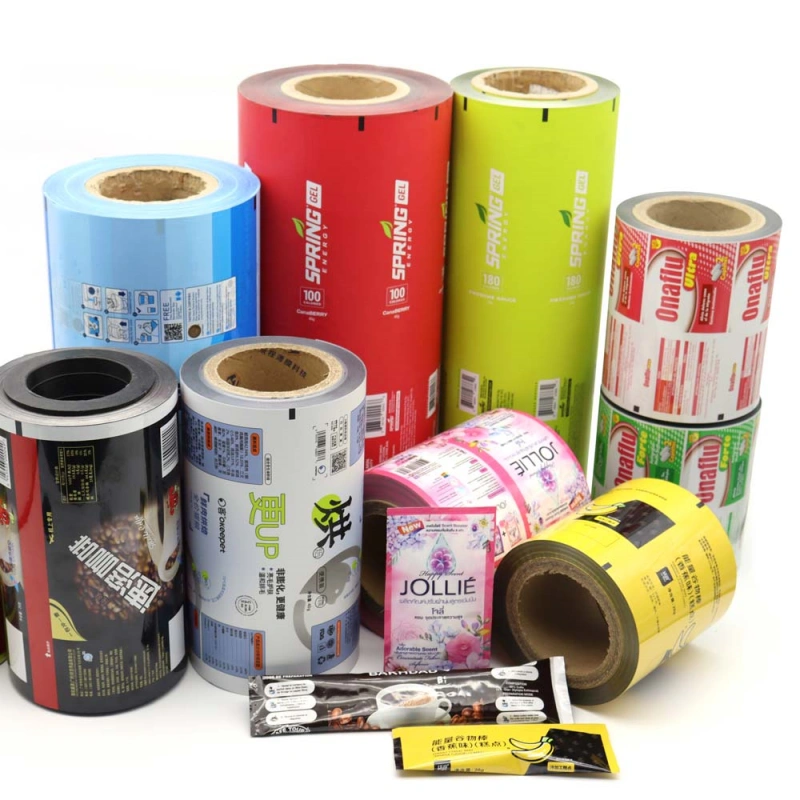
If you’ve ever watched a high-speed snack or coffee production line, you’ve seen roll stock packaging in action — even if you didn’t know what to call it. That large reel of film feeding into a machine, getting pulled, formed into a pouch shape, filled, and sealed in one continuous motion — that’s roll stock. It’s one of the most widely used packaging formats in food manufacturing globally, and also one of the most consistently misunderstood by brands that are new to it.
The short version: roll stock is flexible packaging film supplied on a reel rather than pre-made into pouches. Instead of receiving finished bags that you fill and close, you receive a roll of laminated film — sometimes printed, sometimes plain — that gets converted into bags on your filling and sealing equipment. The pouch is made and filled in the same step, on the same machine, at the same time.
That’s a fundamentally different production model than buying pre-made pouches, and it has real implications for cost, speed, minimum order quantities, and operational complexity. Whether it’s the right choice depends almost entirely on where you are in your production journey.
How It Actually Works on the Line

Roll stock film is used on form-fill-seal (FFS) machines, which come in two main configurations. Vertical FFS (VFFS) machines pull the film downward, form a tube around a central collar, create a bottom seal, fill the product through the top, and then create a top seal before cutting the finished pouch free. This is the setup you’ll typically see for granular products — coffee, nuts, rice, protein powder, frozen vegetables. Horizontal FFS (HFFS) machines run the film horizontally and are more common for products that need to be placed rather than dropped or poured, like fresh produce, bakery items, or medical devices.
The film feeds from the reel through a series of rollers and tension controls that keep it running flat and at consistent tension. Any variation in film tension, thickness, or surface coefficient of friction (COF) will show up as registration errors, uneven seals, or jamming — which is why film specification matters more than most buyers expect.
From a supplier’s side, producing roll stock is actually simpler than producing pre-made pouches. There’s no bag-forming step, no zipper welding, no die-cutting or bottom gusset folding. The film goes through printing and lamination, gets wound onto a core, and ships. The complexity gets transferred to your production floor, which is either an advantage or a problem depending on your setup.
The Cost Argument — and Where It Gets More Complicated

The reason most brands eventually ask about roll stock is cost. And the cost argument is legitimate — at sufficient volumes, film on a reel is meaningfully cheaper per unit than pre-made pouches. You’re paying for material and print only, not for the bag-forming labor and equipment that your pouch supplier otherwise absorbs. For a high-volume operation running millions of units per year, that cost delta adds up to a significant number.
But the comparison only works if you already have the filling equipment, or if you’re willing to invest in it. A basic VFFS machine starts around $30,000–$50,000 for entry-level models and runs well into six figures for higher-speed or multi-format machines. A semi-automatic tabletop unit might come in lower, but it won’t run at the throughput that makes roll stock economics attractive. If you’re packaging a few thousand units a month, the equipment cost will take years to recover through material savings — and by that point, your product mix may have changed entirely.
We’ve had customers come to us specifically asking to switch from pre-made pouches to roll stock because someone told them it would reduce their packaging costs by 30–40%. That number is sometimes achievable — but only when the volumes justify the equipment, when the film specification is dialed in correctly, and when the production team has the experience to keep machine waste low. Early-stage runs on a new roll stock setup typically waste 8–15% of film in setup, registration, and seal calibration before things settle down. Pre-made pouches don’t have that waste factor.
Film Structure and What You’re Actually Specifying

Roll stock film is typically a laminated structure — multiple layers bonded together, each contributing something different to the finished pouch performance. The outer layer is usually PET or OPP for printability and durability. The inner layer, which becomes the inside of the pouch and contacts the product, needs to be heat-sealable — most commonly PE or CPP. Between those, you might have an aluminum foil layer for high-barrier applications, a nylon layer for puncture resistance, or a metallized PET layer as a lighter-weight barrier alternative.
| Film Structure | OTR | MVTR | Typical Application |
|---|---|---|---|
| OPP / PE | Low barrier | Low barrier | Dry snacks, short shelf life |
| PET / PE | Medium | Medium | General food, non-sensitive products |
| PET / VMPET / PE | Medium-high | Medium-high | Coffee, tea, pet food |
| PET / AL / PE | High | High | Long shelf life, export, liquids |
| PET / AL / NY / PE | Very high | Very high | Sensitive powders, pharmaceuticals |
| Kraft / VMPET / PE | Medium-high | Medium-high | Specialty coffee, natural foods |
One specification that doesn’t get enough attention in most buyer conversations is COF — the coefficient of friction of the inner film surface. On a VFFS machine, the film needs to slide consistently over the forming collar and through the feed mechanism. If the COF is too high, the film drags and the machine struggles to maintain consistent tension. If it’s too low, the film slips unpredictably and registration marks — the small printed targets that tell the machine where to cut — get misread. We’ve had customers come to us frustrated that their new film supplier’s material “doesn’t run right,” and nine times out of ten it’s a COF or thickness consistency issue, not a laminate defect.
Printed vs. Unprinted Roll Stock

Roll stock can be supplied either printed or plain. Printed roll stock goes through gravure or flexographic printing before lamination — the design is embedded in the laminate structure, typically on the reverse side of the outer PET layer, so it’s protected from scuffing and contact. The result is the same high-quality print you’d see on a pre-made pouch.
Unprinted (plain) roll stock is used when brands apply labels separately, or when the packaging is genuinely generic — bulk industrial applications, internal manufacturing uses, or cases where a self-adhesive label provides all the branding. Some brands use unprinted roll stock as a way to manage SKU flexibility: one film specification runs across multiple products, and a label swap handles the differentiation. This works reasonably well for lower-volume lines but loses the premium shelf appearance that printed laminates deliver.
Minimum order quantities for printed roll stock are higher than for plain film, because you’re committing to a print run in addition to a material run. A typical minimum for a printed roll stock order from our facility runs around 300–500kg of finished film, which translates to tens of thousands of individual pouches depending on the size. For smaller operations, that’s a lot of inventory commitment upfront. Pre-made pouches in those situations often make more sense purely from a cash flow and storage standpoint.
Registration, Splicing, and the Details That Actually Matter in Production

A few practical things that don’t come up in most supplier brochures but matter a lot once you’re running.
Roll-to-roll splicing is inevitable — every roll has an end, and your machine needs to transition to a new roll without stopping the line. Most modern FFS machines have auto-splice capability, but it requires that your film rolls have consistent core diameter, consistent wind tension, and clearly marked splice points. When this isn’t done properly, you get a production stop and a section of wasted film at every roll change. It sounds minor until you’re doing ten roll changes per shift.
Print registration on VFFS machines depends on eye marks — small printed rectangles, usually in black, that the machine’s optical sensor reads to determine cut position. If the printing run has inconsistent registration (the eye marks shift position relative to the graphic) it shows up as miscut pouches where the design is off-center or the seal crosses through printed graphics. This is a printing quality issue, not a machine issue, but it’s often blamed on the equipment first. When sourcing printed roll stock, it’s worth asking your supplier about their registration tolerance specification.
Temperature and dwell time for sealing need to be calibrated specifically to your film’s inner sealant layer. PE seals at different temperatures than CPP; thicker PE layers need more dwell time than thin ones. These parameters should come from the film supplier as part of the technical data sheet. If you’re switching film suppliers without adjusting machine parameters, you’ll almost certainly get seal failures on the first few runs.
Who Roll Stock Is Actually Right For
Honestly, roll stock makes the most sense for operations that are already running FFS equipment and are looking to optimize material costs and supply chain control. It also suits brands that are producing a relatively narrow range of pouch sizes — because every format change on a VFFS machine requires a changeover that takes time and wastes film.
For a brand that’s still growing, still experimenting with formats, or producing under a certain volume threshold, pre-made pouches usually offer more flexibility with less operational overhead. The per-unit cost is higher, but you’re not carrying the equipment investment, the setup waste, or the technical burden of managing film specifications and machine parameters.
The question we ask customers who come to us about roll stock is simple: what are your monthly volumes per SKU, and do you have the machine? If the answer to either part is “not yet,” the conversation usually shifts back toward pre-made. That’s not a deflection — it’s just the honest answer, and it saves everyone time.
BN Pack supplies roll stock film in custom laminate structures, printed or plain, for VFFS and HFFS applications across food, coffee, pet food, and supplement categories. We provide full technical data sheets including COF, seal temperature range, and registration specifications with every order. Contact us to discuss your film specification.