
Walk into any specialty coffee shop, browse any roaster’s website, or scroll through a farmers market on a Saturday morning — and you’ll notice something almost immediately. The bags are brown. Not always, but often enough that kraft paper has become something close to a visual shorthand for “good coffee.” That’s not a coincidence, and it’s not just about aesthetics. There are real, practical reasons why kraft paper became the dominant material choice for coffee packaging, and understanding them helps explain why we still recommend it to the majority of small and mid-sized roasters we work with.
That said, kraft is not a perfect material. It has limitations that trip up brands who don’t fully understand what they’re buying. So rather than just explaining why it’s popular, this article is really about helping you decide whether it’s the right choice for your specific situation.
The Material Itself — What Kraft Paper Actually Is

Kraft paper gets its name from the German word for “strength,” which is fitting. The kraft pulping process uses sodium sulfide and sodium hydroxide to break down wood pulp in a way that preserves the long cellulose fibers. Those long fibers are what make kraft paper noticeably tougher than standard paper — more resistant to tearing, more forgiving under the stress of filling lines and shipping.
In its natural unbleached state, kraft paper is that familiar brown color. The brownness isn’t a manufacturing flaw; it’s what you get when you skip the bleaching step. Bleached kraft paper exists and can be printed on more vividly, but natural kraft has a warmer, more textured look that a lot of coffee brands actively want.
For coffee packaging specifically, kraft paper is almost never used alone. It’s typically laminated — bonded to other film layers that provide the moisture resistance and oxygen barrier that paper on its own simply cannot deliver. When a customer tells us they want “a kraft coffee bag,” what they usually mean is they want a bag that looks like kraft on the outside. The performance comes from what’s underneath.
Why the Coffee Industry Gravitated Toward It
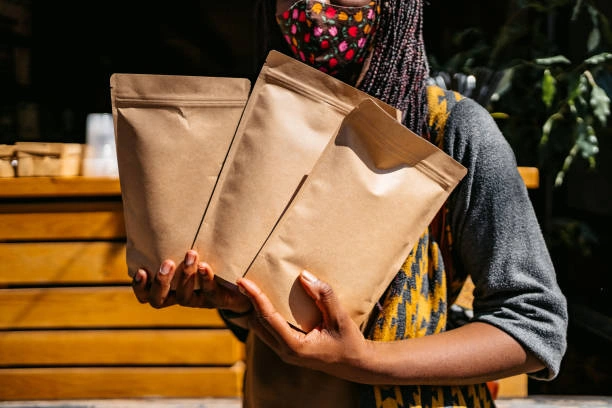
Part of this is historical accident. Specialty coffee as a retail category grew up alongside a broader craft food movement in the 2000s and 2010s — artisan bread, small-batch jam, farm-direct vegetables. Brown kraft paper was the visual language of that movement. It signaled handmade, small-batch, not-a-big-corporation. Early specialty roasters adopted it partly because it was affordable, partly because it printed well enough for a simple two-color design, and partly because it just looked right next to a pour-over kettle.
But the aesthetic argument alone doesn’t explain why kraft is still the dominant choice twenty years later, now that coffee packaging has become much more sophisticated. The reason it stuck is that it actually performs well within the laminate structures that modern coffee bags require.
Coffee is a demanding product to package. Freshly roasted beans off-gas CO₂ for days after roasting — which is why almost every serious coffee bag has a one-way degassing valve. The bag material needs to handle that internal pressure without delaminating or developing pinholes at the seams. Kraft paper, because of its fiber structure, has a natural degree of flexibility and resilience that works well in this context. We’ve run the same flat-bottom bag design in both kraft and full-foil constructions, and in our experience, the kraft laminate tends to hold its shape slightly better over time, particularly at the gusset folds. It’s not a dramatic difference, but it’s something experienced packers notice.
On filling lines, kraft laminates also tend to run more consistently than some synthetic alternatives. The material has a natural rigidity that feeds through form-fill-seal machines predictably. Thinner or more slippery films can cause registration issues and inconsistent seal widths. This is a practical production detail that matters more than most brands realize when they’re specifying packaging from a distance.
The Sustainability Question

This is where things get more complicated, and frankly where we see the most confusion among buyers.
Kraft paper has a reputation for being environmentally friendly, and there’s some truth to it — paper is biodegradable, renewable, and when sourced from certified forests (FSC or PEFC), it carries meaningful sustainability credentials. But a laminated kraft coffee bag is not just paper. It’s paper bonded to PE film, sometimes with an aluminum foil layer or a metallized PET layer in between. That laminate cannot be recycled in standard paper streams. Putting it in the paper recycling bin does not help.
This is one of the most common misunderstandings we deal with. A customer will ask for a “sustainable kraft bag” because they want something eco-friendly, and they associate the brown kraft look with environmental responsibility. But if that bag has a conventional multi-layer laminate with PE and foil, its end-of-life profile isn’t meaningfully better than a full-foil bag.
The genuinely more sustainable options are kraft bags with PLA-based or water-based barrier coatings, or kraft laminates using certified compostable inner layers. These do exist and we produce them regularly. They’re somewhat more expensive, the barrier performance is slightly lower, and they have stricter handling requirements. But they’re the honest answer if sustainability is the actual goal rather than just the appearance of it.
How Kraft Laminates Are Actually Constructed
Most coffee bags sold today use one of three or four standard laminate structures, and it’s worth understanding what you’re actually getting when you order.
| Construction | Barrier Level | Shelf Life (approx.) | Best For |
|---|---|---|---|
| Kraft / VMPET / PE | Medium-high | 9–12 months | Specialty retail, mid-range roasters |
| Kraft / AL / PE | High | 12–18 months | Longer supply chains, export markets |
| Kraft / PLA coating | Medium | 6–9 months | Certified compostable, DTC brands |
| Kraft / AL / NY / PE | Very high | 18–24 months | Premium, long-shelf-life blends |
The metallized PET (VMPET) structure is the most common for specialty retail coffee. It gives a good balance of barrier performance, cost, and appearance — when you look inside the bag and see a silver interior, that’s the metallized layer. It blocks light and significantly reduces oxygen and moisture transmission, though not to the same level as solid aluminum foil.
Full aluminum foil constructions offer the highest barrier but add weight and cost. They’re more common in commercial and export packaging than in the craft roaster segment, where the target audience is buying a 250g bag every two weeks. For a bag that sits on a café counter and gets used within three months, VMPET is typically sufficient.
Where Kraft Runs Into Trouble
Kraft paper doesn’t handle moisture exposure well at the surface level. If bags are stored in humid conditions during shipping — particularly in sea freight containers where condensation is common — the outer kraft layer can absorb moisture, leading to softening, minor surface mold, and in bad cases, delamination at the edges. This is a known issue for roasters exporting to Southeast Asia or shipping through hot, humid transit routes.
There are ways to mitigate this: tighter laminate bonds, moisture-resistant varnish coatings on the outer surface, or simply choosing a different outer material for those specific routes. But if you’re sourcing kraft bags for a global market and haven’t asked your supplier about surface moisture resistance, it’s worth raising.
Kraft also has printing limitations compared to white or foil surfaces. Natural brown kraft absorbs ink differently, which means light colors — particularly white and yellow — will appear more muted than they would on a white substrate. Brands that want clean, bright color blocking on their packaging often discover this only when they see the first production samples. Digital printing handles this better than flexo, but it comes with its own cost and run-size constraints.
What We Actually Tell Customers
When a roaster comes to us asking for kraft bags, the first thing we want to understand is where the product is going, how long it needs to stay fresh, and what the design actually looks like. Those three factors usually determine whether standard kraft laminate is the right call, or whether something needs to be adjusted.
For a local roaster selling through their own café with quick turnover, a kraft/VMPET/PE stand-up pouch with a one-way valve is a solid, cost-effective choice. For a roaster doing subscription boxes shipped across the country, we’d typically suggest a slightly heavier laminate and pay more attention to the seal width on the degassing valve. For someone exporting to Europe or Japan, the conversation about surface moisture resistance and barrier specification becomes more detailed.
Kraft paper is popular for good reasons. It’s versatile, it looks honest, it performs reliably within its design limits, and it connects to a visual tradition that specialty coffee has built over two decades. But it’s a starting point for a conversation, not a complete answer on its own. The brands that have the best experience with kraft bags are the ones who understand what the material is actually doing — and what it’s depending on the laminate to do for it.
BN Pack manufactures custom kraft coffee bags in stand-up, flat-bottom, and side-gusset formats with your choice of laminate structure, valve type, and finish. We work with roasters from 500-bag sample runs through to full production orders. Get in touch to discuss your specification.